
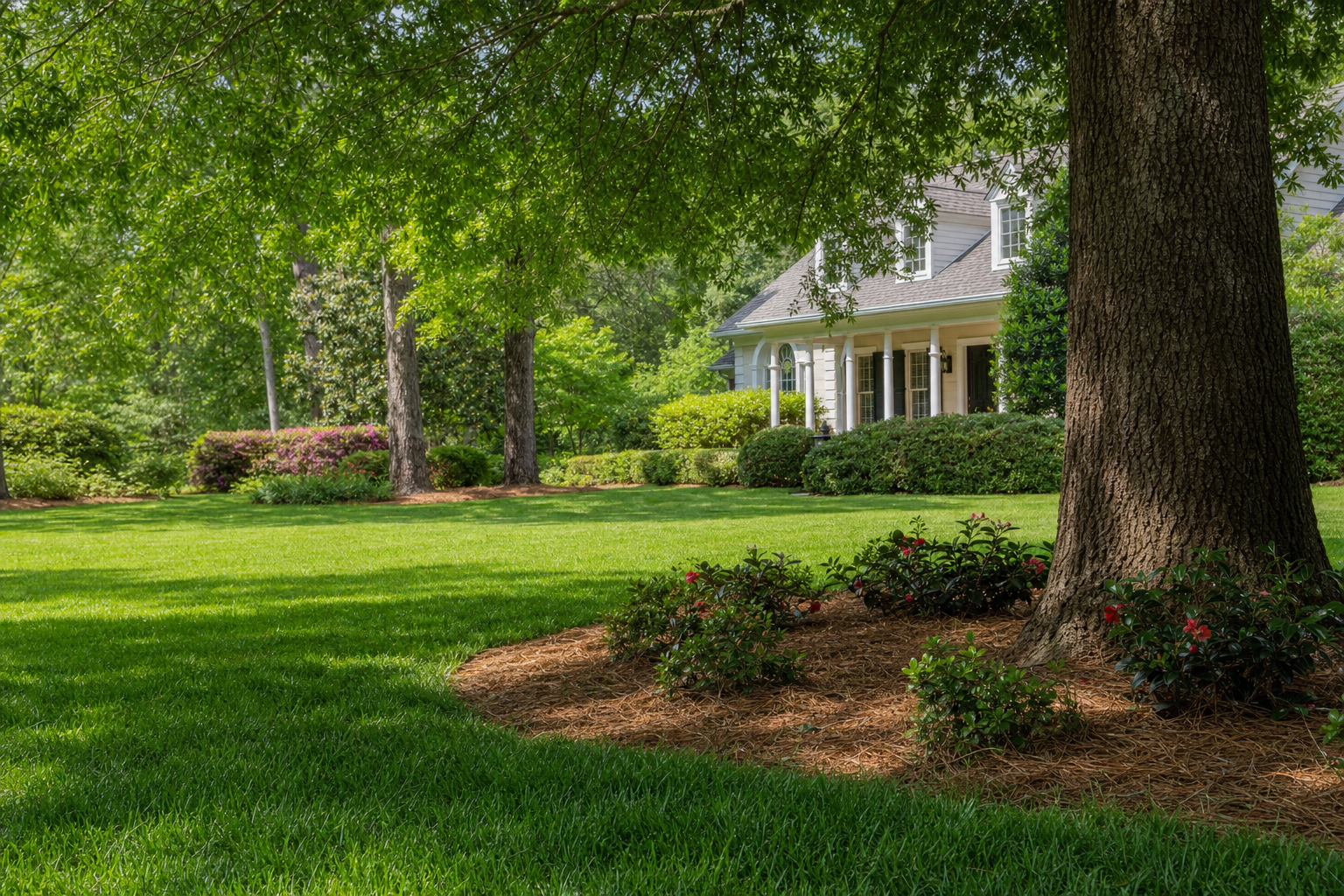
Fertilization in Aiken, SC: What Your Warm-Season Turf Actually Needs This August
The Savannah River separates Augusta, GA from the South Carolina side of the CSRA, but it does not separate the two areas from the same fundamental turf challenges. Augusta, GA properties tend to sit on heavier clay soils, often in older neighborhoods with compacted root zones and tree canopy that complicates sun exposure. Properties in Aiken, SC frequently sit on sandier, faster-draining soil that behaves completely differently under the same fertilizer application. That distinction matters more than most homeowners realize, and it is the core reason that fertilization aiken, sc requires its own approach rather than a copy of whatever works across the river.
Fertilization in Aiken, SC involves applying the right balance of nitrogen, potassium, and micronutrients to warm-season turf, timed to the grass’s active growth cycle. For Bermuda and Zoysia lawns in the CSRA, late summer applications through August build the carbohydrate reserves the grass needs to survive winter and green up quickly in spring. The specific product, rate, and timing depend on soil conditions, turf type, and what the lawn has already received that season.
Key Takeaways
- Aiken’s sandy soil drains faster than Augusta’s clay, which changes how fertilizer moves through the root zone and how often applications may be needed.
- August is one of the most important fertilization windows for warm-season turf in the CSRA, building reserves before growth slows in fall.
- Applying the wrong nutrient ratio in late summer can push excessive top growth at the expense of root development, leaving turf vulnerable heading into dormancy.
- A proper fertilization program accounts for what the lawn has already received, not just what it looks like on the surface.
- Fertilization works best as part of a coordinated program that also addresses weed pressure and soil health through aeration.
How Aiken’s Soil and Climate Shape Every Fertilization Decision
Aiken sits in the Sandhills region of South Carolina, a geological band of ancient coastal plain soils that are notably sandier and more porous than the clay-heavy soils you find in much of Augusta, GA and Evans, GA. That porosity has real consequences for fertilization aiken, sc. Nutrients, especially nitrogen, move through sandy soil quickly. Water carries them down and away from the root zone faster than they would move through clay. This means that a single heavy application that might sustain a lawn in Augusta for six to eight weeks could leave an Aiken lawn nutrient-deficient in half that time.
The flip side is that sandy soil does not hold water or compact the way clay does, which means roots in Aiken often have better natural oxygen access. That can be an advantage, but it also means the turf is more immediately dependent on what you put in, because there is less soil organic matter acting as a slow-release buffer. Our approach to fertilization aiken, sc accounts for this by calibrating application rates to what the soil can actually hold and use, rather than defaulting to a standard regional rate.
The climate layer adds another variable. Aiken averages slightly lower humidity than North Augusta and the riverfront areas, but August temperatures still push well above 90 degrees on most days. Warm-season grasses like Bermuda and Centipede are actively growing through this heat, but they are also under stress. Fertilizing during peak heat requires careful attention to nitrogen form. Slow-release nitrogen sources reduce the risk of burning stressed turf and deliver nutrients over a longer window, which suits Aiken’s fast-draining soil particularly well.
What Does the Fertilization Process Actually Look Like?
When our team arrives for a fertilization visit, the first thing we are doing is not pulling a spreader off the truck. We are reading the lawn. Color, density, growth pattern, and any visible stress or disease symptoms all factor into what we apply and at what rate. A lawn showing signs of disease pressure or insect activity needs those issues addressed before or alongside fertilization, because pushing growth into a lawn that is already fighting a pathogen or pest can accelerate the damage rather than correct it.
For most Aiken properties in August, we are working with a granular slow-release product applied with a calibrated rotary spreader. The goal is even, consistent coverage across the turf canopy without overlapping or missing strips. After application, if conditions allow, we want the product watered in, either by the homeowner running irrigation or by natural rainfall within 24 to 48 hours. This activates the fertilizer and moves it into the root zone where it can be taken up.
The timeline from application to visible response varies. With slow-release products, you are typically seeing deeper green color and improved density within two to three weeks. Faster-release formulations can show color change sooner, but they also carry more risk in high heat and on sandy soil. Our fertilization program is structured around the full season, so each visit builds on the previous one rather than treating every application as a standalone event. If you have been following a program through spring and summer, your August application is completing a nutritional arc, not starting from scratch.
How Do You Know When Your Lawn Needs Fertilization?
The most obvious signal is color. Warm-season turf that is running low on nitrogen fades from a deep, saturated green to a lighter, washed-out yellow-green. This is different from drought stress, which tends to show as a blue-gray tint before the grass goes dormant. Nitrogen deficiency shows up as a general pallor across the whole lawn rather than in isolated patches.
Thin, slow-growing turf is another indicator. If your Bermuda or Zoysia is not filling in bare areas through summer, or if mowing frequency has dropped significantly without a corresponding drop in rainfall, the lawn may not have the nutrients it needs to sustain active lateral growth. Sandy soils in Aiken can reach this point faster than homeowners expect, particularly if the lawn missed a spring application or if heavy rain events flushed nutrients out of the root zone earlier in the season.
Weed pressure can also be a downstream indicator. A dense, well-fed lawn crowds out weeds through competition. A fertilization aiken, sc program that falls behind allows turf to thin, and that open canopy becomes an invitation for crabgrass, goosegrass, and other opportunistic species. Addressing the fertility deficit and pairing it with a weed control program is almost always more effective than treating weeds alone.
For properties in North Augusta, Edgefield, or McCormick with similar sandy or transitional soil profiles, the same principles apply. The CSRA’s SC side shares enough geology that what works in Aiken translates well across these communities with minor adjustments.
Frequently Asked Questions
Is August too late to fertilize warm-season turf in Aiken, SC?
August is not too late for warm-season grasses like Bermuda, Zoysia, or Centipede in the Aiken area. These grasses remain actively growing through August and into September, and a properly timed late-summer application builds the carbohydrate reserves the turf needs before it goes dormant. What you want to avoid is a heavy nitrogen application in late September or October, when the grass is beginning to slow down and cannot use the nutrients effectively.
How is fertilization in Aiken different from fertilizing a lawn in Augusta, GA?
The primary difference is soil texture. Aiken’s Sandhills soil drains faster and holds fewer nutrients than the clay-heavy soils common in Augusta neighborhoods. This affects both the product selection and the application rate. In Aiken, slow-release nitrogen sources are particularly important because they reduce leaching and match the pace at which the turf can actually absorb nutrients. Application intervals may also differ based on how quickly the soil releases what has been applied.
Can I fertilize my lawn if it already has a disease or insect problem?
Fertilizing into an active disease or insect problem requires caution. Pushing new growth with nitrogen can worsen certain fungal diseases, because soft, lush tissue is more susceptible to infection. Our team assesses the lawn’s overall health before any fertilization visit, and if we see signs of lawn disease or insect damage, we address those conditions as part of the same visit or recommend treating them first.
How many fertilization visits does a lawn in Aiken typically need per year?
Most warm-season lawns in the Aiken area benefit from multiple applications spread across the growing season, from spring green-up through late summer. The exact number depends on the turf type, soil conditions, and what the lawn has already received. We provide custom estimates based on the specific property rather than a flat per-visit rate. You can reach our team through the contact page to discuss what your lawn’s history and current condition suggest.
August applications of fertilization aiken, sc are most effective when the turf goes into them healthy, hydrated, and free of competing stress. If your irrigation has kept up with the heat and the lawn has been on a consistent program, this final push before fall sets the stage for a strong dormancy and an earlier, more uniform spring green-up next year.


