Your Shrubs Are Losing the Fight – And the Insects Are Winning
If you have walked your property in Evans, GA this July and noticed that the canopy along your fence line looks thinner than it should, or that your hollies and gardenias have a strange dusty or sticky residue on the leaves, you are not imagining it. The combination of Augusta, GA’s punishing summer heat, high humidity, and the dense ornamental plantings that define most Evans neighborhoods creates ideal conditions for insects to move in quietly and do serious damage before most homeowners realize what is happening. By the time leaves are yellowing, curling, or dropping, the infestation is usually well established.
Shrub and tree insect control in Evans, GA is not a once-a-season task. In July, insect pressure on ornamentals is at or near its peak, and the damage compounds quickly. A gardenia that looked fine in May can be heavily infested with scale by midsummer. A crape myrtle that is not monitored can develop a sooty mold problem rooted in an aphid population that has been feeding on it for weeks. The symptoms are visible. The cause is almost always biological, and it is treatable, but timing matters.
We see this pattern across Evans and into neighboring Martinez and Grovetown every summer. Homeowners notice something is off, try to address it themselves, and often make the problem worse or miss the actual pest entirely. This article walks through what is happening to your plants, why it is so predictable in this area, and what effective treatment actually looks like.
Shrubs and trees in Evans, GA are most commonly damaged by scale insects, spider mites, aphids, and borers during summer months. These pests are managed through targeted insecticide applications, dormant oil treatments, or systemic treatments depending on the pest and plant type. Professional identification is critical because the wrong treatment can harm beneficial insects or fail entirely.
Key Takeaways
- July is peak season for scale, mites, and aphids on ornamental shrubs and trees in the Evans, GA area.
- Sooty mold on leaves is usually a secondary symptom of an active insect infestation, not a disease.
- Misidentifying the pest is the most common reason DIY treatments fail.
- Borers and other internal feeders require systemic treatments that surface sprays cannot reach.
- Professional shrub and tree insect control in Evans, GA includes both treatment and a follow-up inspection to confirm the infestation is resolved.
What Is Actually Attacking Your Shrubs and Trees?
The most common culprits we find on ornamentals in Evans this time of year fall into a few categories. Scale insects are among the most destructive and the easiest to miss. They look like small waxy bumps on stems and leaf undersides, not like a typical bug. They feed by piercing plant tissue and extracting sap, and they excrete a sticky substance called honeydew that coats leaves and attracts sooty mold. If your shrubs look like someone dusted them with black powder, scale or aphids are almost certainly involved.
Spider mites thrive in hot, dry conditions and reproduce rapidly in July. They are nearly invisible to the naked eye but leave a telltale fine webbing on leaf undersides and cause a stippled, bronzed appearance on foliage. Aphids cluster on new growth and cause leaves to curl and distort. And then there are borers, which are arguably the most serious because they work from inside the plant outward. By the time you see exit holes or sawdust-like frass at the base of a tree, the damage is already internal. Our shrub and tree disease and insect service addresses all of these, but the treatment approach is different for each one.
Why Is Shrub and Tree Insect Control in Evans, GA Such a Consistent Problem Every Summer?
Evans is a well-established suburban community with mature tree canopies, dense foundation plantings, and a lot of ornamental variety. That diversity is part of what makes properties here beautiful, and it is also part of what makes insect pressure so persistent. Different species attract different pests, and when you have hollies next to gardenias next to crape myrtles next to Leyland cypresses, you are essentially offering a buffet.
The clay-heavy soil common throughout the CSRA region also plays a role. Plants that are stressed from poor drainage or compaction are more vulnerable to insect attack. A gardenia that is struggling to pull nutrients through compacted soil is a much easier target for scale than a healthy, well-fed plant. This is why shrub and tree fertilization is not separate from insect control in our approach. A plant in good nutritional health resists infestation better and recovers faster when treatment is applied. We have written about how local soil conditions affect plant health in our post on why Grovetown’s clay soil demands attention, and the same principles apply across Evans properties.
Summer heat compounds everything. High temperatures accelerate insect reproduction cycles, meaning populations that are manageable in June can become overwhelming by mid-July. Waiting to see if the problem resolves itself is rarely a good strategy this time of year.
Common Mistakes Homeowners Make Before Calling Us
The most frequent mistake we see is applying a general-purpose insecticide spray without identifying the pest first. Contact sprays do nothing to borers feeding inside woody tissue. They are also largely ineffective against scale insects that are protected by their waxy coating. Spraying the wrong product at the wrong time can eliminate beneficial predatory insects, like lacewings and parasitic wasps, that are naturally suppressing your pest population. You end up worse off than before.
Another common error is treating the symptom rather than the source. Sooty mold, for example, is a fungal growth that feeds on honeydew. Washing it off or applying a fungicide addresses the appearance but not the insect colony producing the honeydew underneath. The mold returns within weeks. The same logic applies to the signs your plants need shrub and tree disease treatment, where disease and insect damage are often confused for each other.
Timing is also critical. Many insecticides are most effective against juvenile insects, called crawlers in the case of scale, and miss adults entirely. Without knowing the pest’s life cycle, a homeowner applying product at the wrong stage may see no results and assume the infestation is untreatable.
What Effective Treatment Actually Looks Like
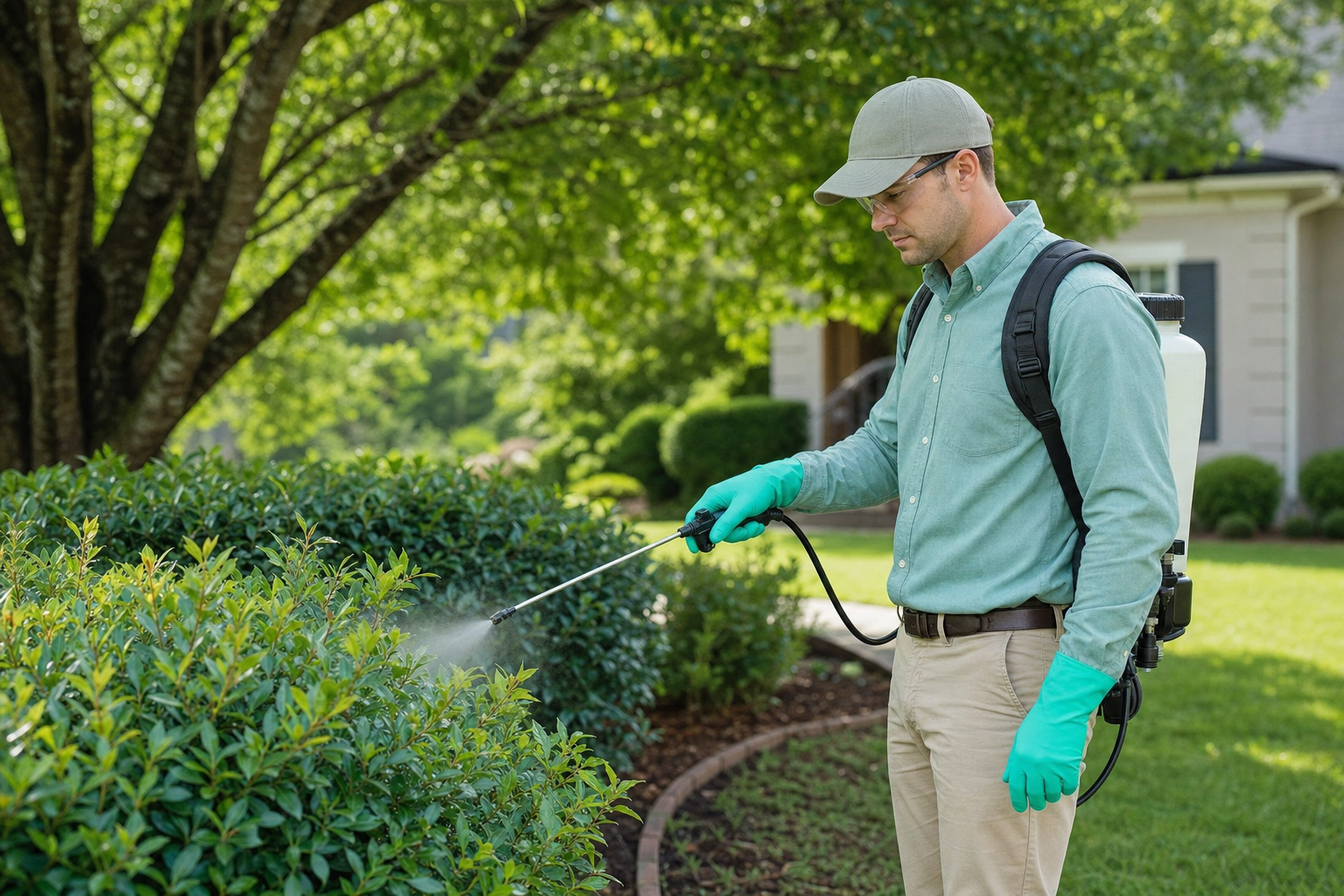
Effective shrub and tree insect control in Evans, GA starts with a proper inspection. We identify the specific pest, assess the severity of the infestation, and evaluate the overall health of the plant before recommending a treatment protocol. For soft-bodied insects like aphids and mites, targeted applications of horticultural oil or insecticidal soap can be highly effective when timed correctly. For scale, we use appropriate insecticides timed to the crawler stage, or systemic treatments that the plant absorbs and that affect insects feeding on it. Borers require systemic soil drenches or trunk injections that reach the feeding zone inside the wood.
We also look at what is contributing to plant stress. If a shrub is deficient in nutrients, we will discuss fertilization as part of the recovery plan. A treated but malnourished plant is still a vulnerable plant.
When Should You Call a Professional for Shrub and Tree Insect Control in Evans, GA?
If you are seeing leaf drop, significant discoloration, sticky residue, visible webbing, or any kind of frass or exit holes on your trees and shrubs, the time to call is now, not at the end of summer. Insect populations in July are growing, not slowing down, and ornamentals that are heavily defoliated going into fall have a much harder time recovering. Repeated defoliation over multiple seasons can kill established shrubs and trees that took years to grow.
If you are unsure whether what you are seeing is insect damage or a disease issue, that uncertainty itself is a reason to get a professional set of eyes on it. Our team serves Evans and the surrounding communities including Appling, Harlem, and North Augusta. You can reach us through our contact page to schedule an inspection. The earlier we get in, the more of your plants we can protect.
Frequently Asked Questions
What are the most common insects damaging shrubs and trees in Evans, GA in summer?
Scale insects, spider mites, aphids, and various borer species are the most frequent problems we see on Evans ornamentals during summer. Scale and aphids are especially common on gardenias, hollies, and crape myrtles. Borers tend to target stressed trees, including ornamental cherries and certain pines common in the area.
Can I treat shrub and tree insects myself, or do I need a professional?
Some light aphid infestations on accessible shrubs can be managed with correctly applied horticultural oil or insecticidal soap. However, misidentifying the pest or using the wrong product at the wrong time frequently makes the problem worse. Borers, heavy scale infestations, and any insect problem on large trees should be handled professionally.
How do I know if my shrub has an insect problem or a disease?
Insect damage often presents with visible signs like sticky residue, webbing, bumps on stems, or distorted new growth. Disease tends to produce spotting, blighting, or cankers without those physical signs. That said, the two frequently occur together because insects weaken plants and make them more susceptible to disease. A professional inspection is the most reliable way to distinguish between them. Our post on signs your plants need shrub and tree disease treatment covers this in more detail.
How many treatments does it take to get shrub and tree insects under control?
It depends on the pest and the severity of the infestation. Some insect problems resolve with a single properly timed treatment followed by a monitoring visit. Scale infestations often require two applications timed to the insect’s life cycle. We do not give a blanket answer because the right protocol depends entirely on what we find during the inspection.


